
Written by Laura Spaulding, Founder & CEO of Spaulding Decon (20+ years in biohazard remediation & property restoration). This guide is based on a real cleanup video and the field process involved.
This guide is definitely not graphic but it is also not for the faint of heart. At Spaulding Decon, we recognize that unexpected deaths occur and we are here to help families get through the cleanup process. What many families don’t know about situations like these is that once the police or investigators finish their job, the biohazards and odours remain within the property and they can also spread. Spaulding Decon is a professional unattended death cleanup company with years of experience and a certified approach. To show you how we deal with these types of situations, we selected one of our case studies of a California man to help you understand the cleanup process better and so you know what to expect.
Who Cleans Up After the Police Leave?
Whether it’s the aftermath of a crime scene or an unattended death, the human body goes through several key stages of decomposition. The process usually involves law enforcement officials, whose job it is to investigate the causes and circumstances surrounding the death.
However, the cleanup happens by licensed and insured private companies, which remediate a property that’s been affected by odours and biohazardous risks after such deaths. At Spaulding Decon, we know and deeply understand the trauma such an event can cause to a grieving family.
And we also know that a simple do-it-yoursel “deep clean” is not sufficient to eliminate the health risks involved. Our process involves more than materials removal. As part of our decomposition cleanup, we also perform decontamination, testing, and provide families with documentation to support our efforts.
What “biohazard cleanup” usually includes
When a body begins to decompose, it goes through several important processes. Among these include a release of bodily fluids which can seep into mattresses and bedding, carpets, and even the subfloor of the property in which it was discovered. Our biohazard cleanup process involves several key steps that are essential to ensure the property is restored to a clean and risk-free state. These steps include:
- Removal of porous materials
- Treatment of affected structural layers
- Safe disposal
- Disinfection and decontamination, and
- Odor remediation
Why Decomposition Spreads Through a Room Faster Than People Expect
Decomposition is a natural process. However, certain key factors influence the rate at which it progresses. Colder temperatures and dry places usually slow down the process somewhat. On the other hand, heat and humidity can speed it up. In this case, a man from California had moved to Florida where he was discovered to have passed away. The conditions surrounding his death included extreme heat and humidity with the air conditioning off and the windows open.
Heat and humidity accelerate decomposition
In short, heat and humidity accelerate the decomposition process. When a body is in a hot and humid environment, it breaks down much faster because it creates the perfect “breeding ground” for the two main drivers of decay: bacteria and insects.
Heat acts like an accelerator. Just as food spoils faster on a warm counter than in a fridge, the internal bacteria already present in the body multiply rapidly in the heat, causing the body to bloat and soften more quickly.
High humidity adds to this by preventing the body from drying out. If the air is dry, a body might “mummify” or become leathery, which actually preserves it; however, moisture keeps the tissues soft and “juicy,” making it easier for bacteria to thrive and for insects like flies to lay eggs.
Together, the warmth and dampness turn the body into a highly efficient ecosystem for decomposers, significantly speeding up the timeline of natural breakdown.
How fluids travel from bed → carpet → subfloor
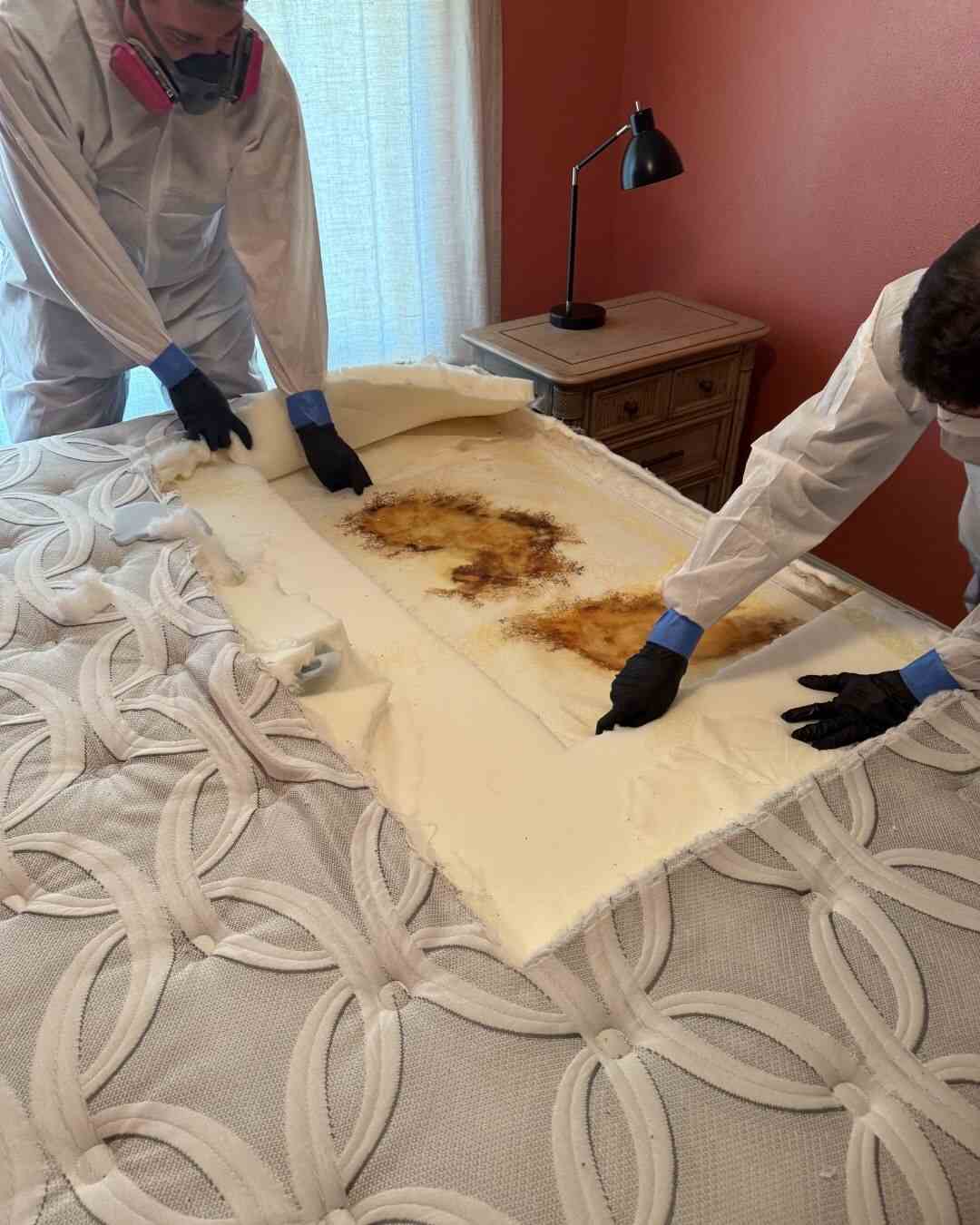
The case of the California man saw our team begin the process of cleaning by an initial inspection of the affected premises. We first noted significant mattress and boxspring saturation of bodily fluids. These were then absorbed by the carpet/padding and went onto the subfloor. We also noted that we had to tack strip the edges, seams, baseboards/drywall contact points to get the room in pristine and risk-free condition once again.
What We Found on This Job
Below, you’ll read a short summary of the events of this particular clean up job.
Watch our team in action as we navigate the complexities of this specific Florida case study, from initial inspection to final subfloor decontamination.
The main contaminated zone
In this case, we noted that the main contaminated zone was the bed and mattress. However, upon removal and stripping of the mattress, we saw that some fluids had seeped into the boxspring wood. There were also body fluids in the carpet. Furthermore, there was subfloor contamination as well, as we noticed that once we had removed the carpet, the subfloor needed to be treated, too.
The first thing you notice isn’t always what you see
Unfortunately, body decomposition doesn’t smell good. When our team arrived at the scene, the first thing we noticed was not the room itself but rather the odor. What typically happens is that the odor intensifies when things like bedding are removed. This is why this job isn’t for the faint of heart and it also requires proper personal protective equipment (PPE) as well as respirators as odour removal after death is an essential part of the cleanup process.
The Professional Decomposition Cleanup Process
Whether it’s crime scene cleaning or decomposition or unattended death cleaning, Spaulding Decon’s teams follow the correct processes and work discreetly and with respect and compassion for the families involved. Our professional cleanup process involves the following steps.
PPE and controlling cross-contamination
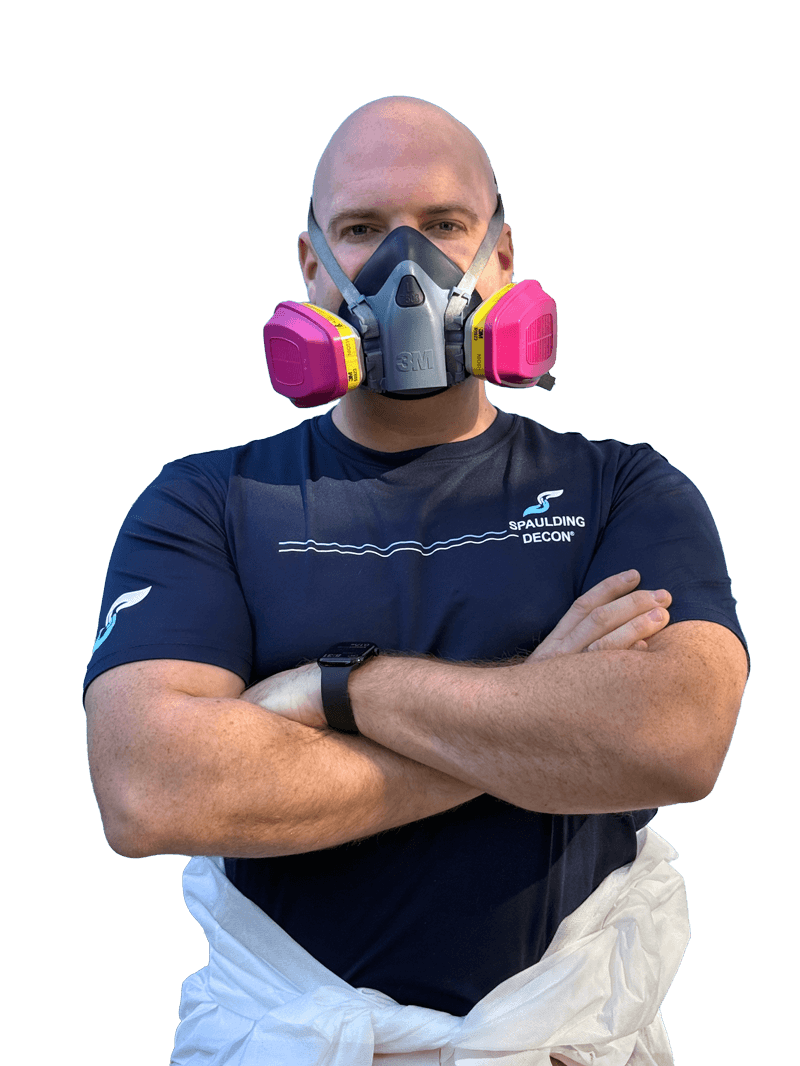
The very first thing we do is to suit up before moving anything in the affected area. There are great biohazardous risks involved in blood or OPIM exposure and that’s why wearing the right PPE, according to OSHA standards, is so essential.
Removing porous materials: bedding, mattress, boxspring, carpet
At Spaulding Decon, we guarantee a thorough process. We don’t just remove affected items. We disassemble them where possible. In this case, this step involved removing the bedding, disassembling the mattress and boxspring, as well as thoroughly removing the carpet to identify any potential areas where the bodily fluids could have seeped through.
Tack strip, edges, and “hidden” contact points
In decomposition processes, fluids are affected by gravity and generally flow down. However, air circulation movements can mean that fluids spread out to areas that are usually hidden to the untrained eye. That’s why it’s important to remove the tack strips, especially if any fluids came into contact with them. At Spaulding Decon, we look out for all hidden contact points and remove and thoroughly clean them as part of our process.
Subfloor treatment and extraction
After the removal of the physical objects in the room that were affected by blood or bodily fluids, our team gets to work on the subfloor. We apply generous volumes of a solution called Part A, which pulls the contamination out of the subfloor. What you’ll see is a visible color change, that is then followed by a vacuum extraction.
Verification: using an indicator to find what you missed
Just because it looks clean doesn’t mean the biological risks aren’t there. That’s why our team uses an indicator to confirm if further treatment is required. This is why we applied a second spray of the Part A solution and re-vacuumed the area afterwards for even deeper and cleaner results.
Odour remediation: ozone machine for 48 hours
As mentioned earlier, the odor is something that lingers in the air for some time after a body has been removed from the premises. An ozone machine for odour removal is a controlled professional step after removal and/or treatment. A key thing to note is that the ozone machine is used for around 48 hours after the cleanup process. However, it should not be used when people are present, according to guidelines by the Environmental Protection Agency.
Real-World Complications on Scene (Yes, This Stuff Happens)
On paper, unattended death may look like a quick process. However, the reality is always more challenging. In this case study, our team faced a power outage due to a blown fuse and inclement weather, which stopped us from completing the job in the natural course of doing things.
Delays don’t change the standard
But even with interruptions and delays, we do not change our high standards for cleanups. Our process remains the same. We remove, treat, verify, and deodorize the premises to ensure they are restored to the pre-biohazard conditions.
Why DIY Cleanup Usually Backfires
Biohazards spread fast. And it’s only natural that you’d want to clean up a room or your premises where an unattended death cleanup has taken place. However, DIY cleanups usually backfire because they are not backed by proven and certified methods, equipment, PPE, and chemicals.
Health risk + spread risk
One of the greatest risks in DIY cleanups is that the risk for cross-contamination is real. This can happen through foot traffic, the movement of materials, and improper PPE and disposal practices. That’s why hiring a professional company is such a key step in this process.
Odour comes back if the source layer remains
Furthermore, as was shown in this case study, odors are a serious risk and can be highly unpleasant to live with. A DIY cleanup may get rid of some of the odor for a short period of time but the fact is that odors return if the source layer remains. This is why we removed the tack strip and deeply cleaned the subfloor, as if not treated and/or removed, the smell can linger for long periods of time.
How Long Does Decomposition Cleanup Take (and What Affects Cost)?
Every case is unique and that’s why we do not have fixed prices. However, there are a few factors that we look at to determine the final cost.
What changes scope
A few examples of these factors include the time for which the body remained undiscovered, the temperature, the presence of any porous materials, the depth of the penetration, whether sealing is needed, and the severity of the odor.
Insurance and documentation
At Spaulding Decon, we work with you and can assist you in preparing the required documentation that your insurers may require. We also provide documentation relating to our scope of work, including non-identifying and discreet disposal documentation and clearance and testing notes.
What To Do If You’re Dealing With This Right Now
If you’re dealing with this type of situation right now, we offer a few suggestions that you may want to follow.
Before the cleanup team arrives
Before the cleanup team arrives, make sure that you limit access to the affected area. Do not disturb any of the items there and keep pets and kids out of the room/premises. Also, it is vital that you do not run fans as these can spread biohazardous particles further.
How to choose a cleanup company
If you’re looking for a cleanup company, you’ll want to work with the best. No one wants to ever be the one to contact a biohazardous cleanup company but the truth is that it happens. When searching for a helping hand, be sure to look for a professional provider that has significant biohazard cleanup experience, that offers you a clear scope of work, is highly discreet to protect your and your family’s privacy, follows proper disposal protocols, and a company that can respond to your needs quickly.
FAQs
Yes, decompositions are very complicated cleanups. When a body has passed on and gone undiscovered for some time, bodily fluids will leak out of the body. Flies are attracted to the smell and will be drawn to it to lay their eggs. We often encounter skin, hair, and strong, unpleasant odors on these projects.
Yes, we have had great success removing such odors from homes and automobiles. We use a combination of removing the source of the odor and utilizing industrial grade ozone machines.
We will remove the carpet if it is saturated. If there are only spots of blood, we can likely extract that from the carpet. If the blood has made it to the padding, we must remove both the carpet and the padding.
If the subfloor is wood, we will remove it and replace it. If the subfloor is concrete, we will chemically extract the fluids, disinfect, and then seal the flooring.
There are two ways to verify it. The first way is the ATP test to show the levels of bacteria. The second is a chemical we use called “indicator”, which bubbles up when it comes into contact with bodily fluids. Only when both of these are absent, we can assume the surface is clean and disinfected.
Ozone is safe when used properly. However, no people, pets, or plants should be inside the property while the machine is running. Ozone works great and should only be used when the source of the odor has been removed.
Home owners insurance covers the cost of the cleanup. Most home owners are only responsible for their deductible.
Our team responds within two hours to the scene.
Expert Insights on Biohazard Remediation

Guide to Biohazard Cleanup and Insurance for Out-of-State Kin
Understanding Unattended Death Cleanup and Its Challenges When faced with the unfathomable of an unattended death of a loved one, many…

Crime Scene Cleanup: A Guide to Safe Biohazard Remediation and Property Restoration
Facing the aftermath of a sudden tragedy or biohazard event can leave you feeling completely overwhelmed. This guide breaks down the…

Spring Cleaning From Top to Bottom: The Deep Clean Your Home Deserves
Professional home cleanout services provide a systematic, deep-level restoration that removes accumulated grime, allergens, and heavy clutter from every corner of…